
I Fell in Love with Manatees—and That Led Me to the Dugong Sea in Miyakojima, Japan

更新日:2月20日
Researcher-Guided Eco Tours: A Research Tour Series That Changes How You See Nature ①
In this series, I share the wonders of nature through a researcher’s lens—clearly and in an easy-to-enjoy way.When you start noticing the discoveries you used to miss, the same ocean and scenery can feel surprisingly different.
Series list: Here
Nice to meet you! I’m Mumi Kikuchi
Hi! I’m Mumi Kikuchi (PhD), the founder of Chikyu Lab.
I’m based on Miyakojima, where I run eco tours and environmental learning programs.
When people hear the word “researcher,” they sometimes imagine lab coats and difficult terms.But what I do is actually very simple.
I go into the field, look with my own eyes, keep notes, and hold onto the question:“Why is that happening?”
That way of seeing nature is something I’d love to enjoy together with you.

It all started with a manatee
When I was a university student, I met a manatee at the Okinawa Churaumi Aquarium—and I fell in love instantly.
The calm, gentle swimming… the adorable face…
That moment changed my life.
It led me to study manatees, and I eventually earned a PhD focused on Amazonian manatee behavior.
After that, my fieldwork expanded to Mexico, Peru, and Cameroon, where I worked with local partners on manatee research and conservation projects.
In Japan, I’ve also collaborated with aquariums—including Churaumi, Toba Aquarium, and Shin-Yashima Aquarium—to study the behavior of manatees.
As I worked with people in different places, I started thinking more and more about what it truly means to “protect” wildlife.

The day I realized: research alone can’t protect wildlife
No matter how many papers we publish, things don’t change easily if that knowledge doesn’t reach the people living alongside wildlife—or the people working in conservation on the ground.
What really matters is translating science into words that people can understand.
And creating moments that lead to real action.
That’s what I began to focus on.
That’s why I started environmental education
This is why I founded the Japan Manatee Ecducation and study lab and began environmental education in Japan and abroad—sharing the beauty of wildlife, the importance of ecosystems, and how closely nature and people are connected.
And over time, I realized something else:
Some things simply can’t be fully shared in a classroom.
Seeing with your own eyes. Feeling it. Noticing something small. Making a new discovery.
And then—another mystery appears.
That kind of experience happens because you are actually there.
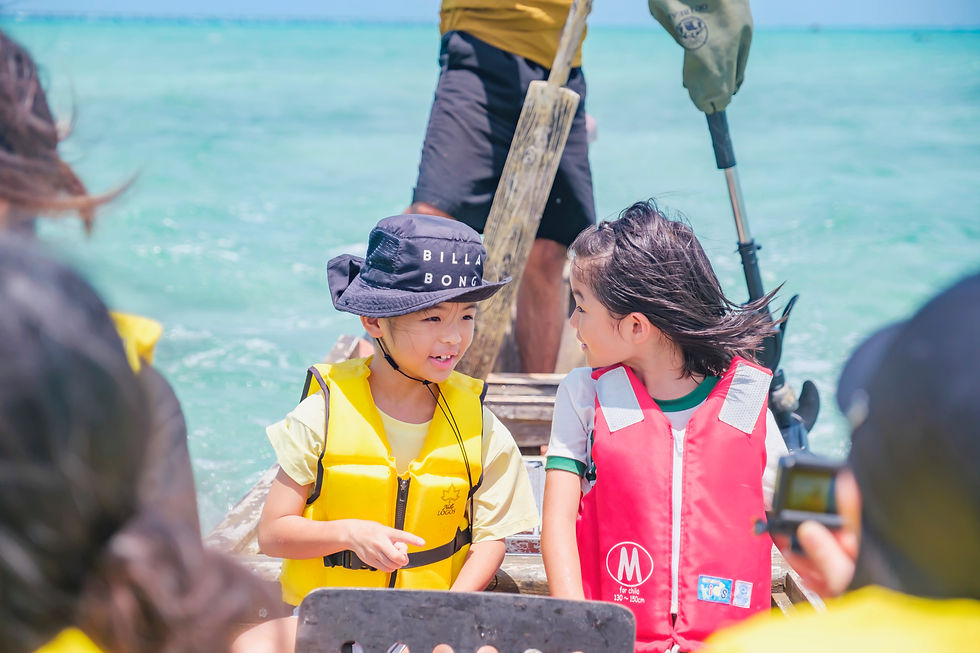
Japan doesn’t have wild manatees—but it does have dugongs
Japan has no wild manatees.But their close relative—the dugong—still lives in the waters of Okinawa.
And yet, dugongs are still not widely known in Japan. That honestly makes me sad.
Around Miyakojima, there have been sightings, and signs of dugongs feeding on seagrass have been reported.
I wanted to use this place—this beautiful island—as a stage where people can learn about the ocean through dugongs and the many creatures that share their world.
That is why I started Chikyu Lab here in Miyakojima.

What we aim for at Chikyu Lab
Our goal is not an eco tour that ends with, “That was fun!”
We want something more:
Observe. Discover. Then a new question is born.
When you add a “research perspective” to an experience, nature becomes much deeper and more exciting.
And when you also learn about local culture and stories—how people and the sea have been connected—Miyakojima may become a much more meaningful place for you, too.
Learning isn’t “hard study.”It’s a joyful experience that expands your world.
I’d love to create that doorway together with you.
Coming next
In the next post, I’ll talk more specifically about:Why I chose a “research tour” instead of a typical sightseeing tour.
Series list: Here
Inquiries are accepted by email. If you would like to join a research tour in Miyakojima, please contact us by email.
Email: info(atmark)chikyulab.com


コメント