
Where Are the Dugongs? Discovering Hidden Traces in Miyako Island

Researcher-Guided Eco Tours: A Research Tour Series That Changes How You See Nature ③
In this series, I share the wonders of nature through a researcher’s lens—clearly and in an easy-to-enjoy way.
When you start noticing the discoveries you once overlooked, the same ocean and scenery can feel surprisingly different.
Series list: Here
n the previous article, I explained how a research tour differs from ordinary sightseeing.
This time, let’s explore a more practical question:
What do we actually observe during a research tour?
Dugongs Are Rare — And Hard to See
“Will we see a dugong?”
This is one of the most common questions.
The honest answer is: probably not.
Dugongs are shy marine mammals and extremely rare in Japan.While they are distributed across parts of the Indo-Pacific, in Japan they are known only from Okinawa, and sightings are very uncommon.
But seeing the animal itself is not the only way to understand its presence.
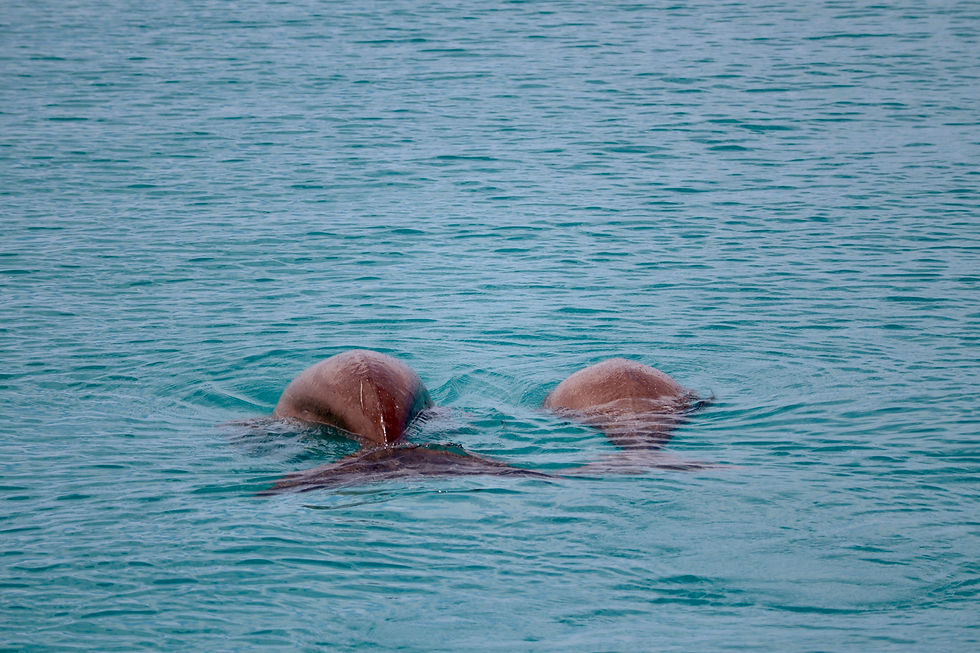
The Most Important Clue: Feeding Trails
Dugongs feed on seagrass.
When they eat, they leave behind distinctive feeding trails on the seabed—long, shallow marks where seagrass has been removed.
At first glance, the seafloor may look ordinary.
But once you know what to look for, patterns begin to appear.
A line through the seagrass.
Marine animals do not always leave visible footprints—
but they leave signs of their lives.

Learning to Notice
At the beginning of the tour, everything may look the same.
Just sand.
Just plants.
Just water.
But when you observe together with a researcher, you begin to ask different questions.
Is this trail fresh?
Could it belong to a sea turtle instead?
Was it caused by waves?
There are no immediate answers.
And that is part of the excitement.
Researchers enjoy the time spent not knowing.
We look carefully. We compare. We think.
That process itself is what we share during the tour.

Not Every Day Reveals a Trace
There are days when we do not find any clear dugong traces.
Nature does not guarantee discoveries.
Still, the act of looking—of intentionally scanning the seagrass and seabed—changes the way you relate to the ocean.
Even without a confirmed trace, you begin to see the sea as habitat, not just scenery.
Invisible, Yet Present
Dugongs are rare in Japan, and encounters are exceptional.
But when we find even a small sign—a feeding trail —we feel something shift.
It becomes real.
That sense of realization often turns into curiosity.
Curiosity can grow into care.
And that transformation—from observation to awareness—is at the heart of our research tour.
It’s Not Only About Dugongs
We do not observe dugong traces alone.
We also look at:
Different types of seagrass
Sea turtles swimming nearby
Turtle feeding marks
Water clarity and currents
Small marine creatures hidden in the shallows
All of these are discoveries in the sea.
Nature may appear quiet, but it is full of information.
Once you start noticing these details, the ocean is no longer just a beautiful view.
It becomes a living ecosystem.

Coming next
In the next article, we will explore another kind of trace—how to distinguish signs left by dugongs from those left by sea turtles.
You may be surprised how much the ocean reveals when you look closely.
Series list: Here
Inquiries are accepted by email. If you would like to join a research tour in Miyakojima, please contact us by email.
Email: info(atmark)chikyulab.com


コメント